Read This Before You Do Anything Else
Search "yellow jackets in my siding" and half the advice you'll find says to spray the entrance and then plug it with caulk or steel wool. That advice will put wasps inside your house.
Here's why. A nest in a wall void has exactly one door. Block it, and a colony of a few thousand insects doesn't politely die — it chews toward the next source of light and air it can find. In a Harrisburg home that is very often the interior: through drywall, around an outlet box, out of a ceiling light, behind baseboard trim. We get these calls every August, and they always start the same way: "I sprayed it and sealed it up, and now they're in the bedroom."
Why Wall and Siding Nests Are Different
A ground nest is out in the yard. A wall nest is inside the building envelope, and that changes things:
- You can't see how big it is. By September a wall colony can hold thousands of workers with no outward sign beyond steady traffic at one gap.
- Hardware-store spray can't reach it. The nest may sit two or three feet in from the opening, up inside the void. A can of wasp spray hits the doorway and agitates everything behind it.
- They're already inside the structure. The only thing between the colony and your living space is a layer of drywall.
- Common entry points in Harrisburg housing: gaps behind vinyl siding J-channel, soffit and fascia seams, unsealed pipe and dryer-vent penetrations, brick weep holes, window and door trim gaps, and the space behind shutters. Older stock — Midtown, Allison Hill, Bellevue Park — has plenty of all of these.
Is It Actually Wasps? It Matters a Lot.
People call everything with a stinger a bee. What's in your wall determines who should handle it and what it costs, so we identify before we treat — always.
Yellow Jackets — the usual answer
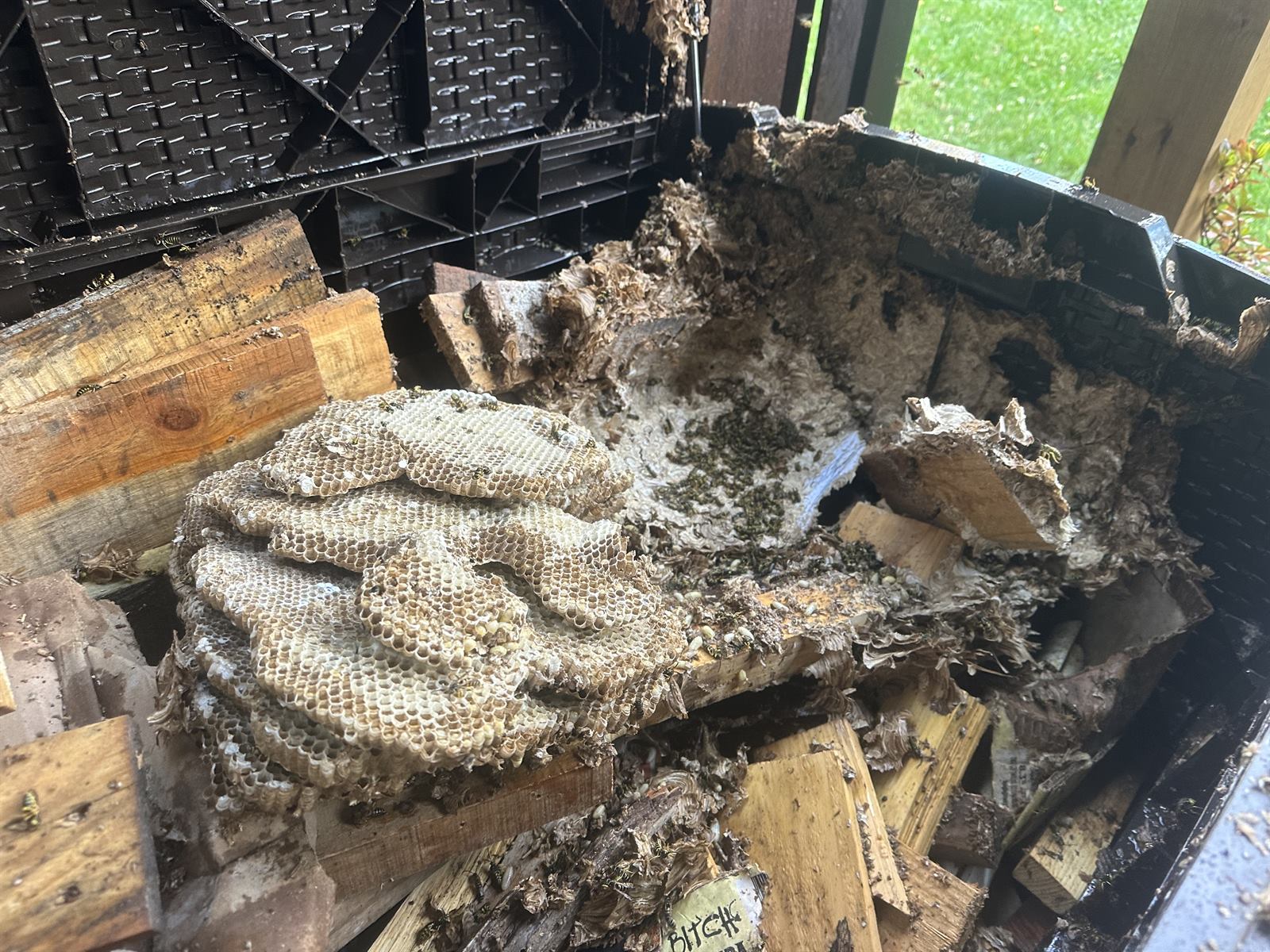
Shiny, hard-edged yellow and black, fast and darting. Heavy two-way traffic at one small gap, building through late summer and peaking August into October. Aggressive when the nest is disturbed, and they sting repeatedly. This is standard pest-control work and what most siding calls turn out to be.
Paper Wasps & Hornets
Paper wasps build small open umbrella-shaped combs under eaves, behind shutters, in soffit corners — visible, smaller colonies, less aggressive. European hornets are big, loud, active at dusk, and nest in wall voids and hollow trees. Both are treated similarly to yellow jackets.
Honey Bees — different job entirely
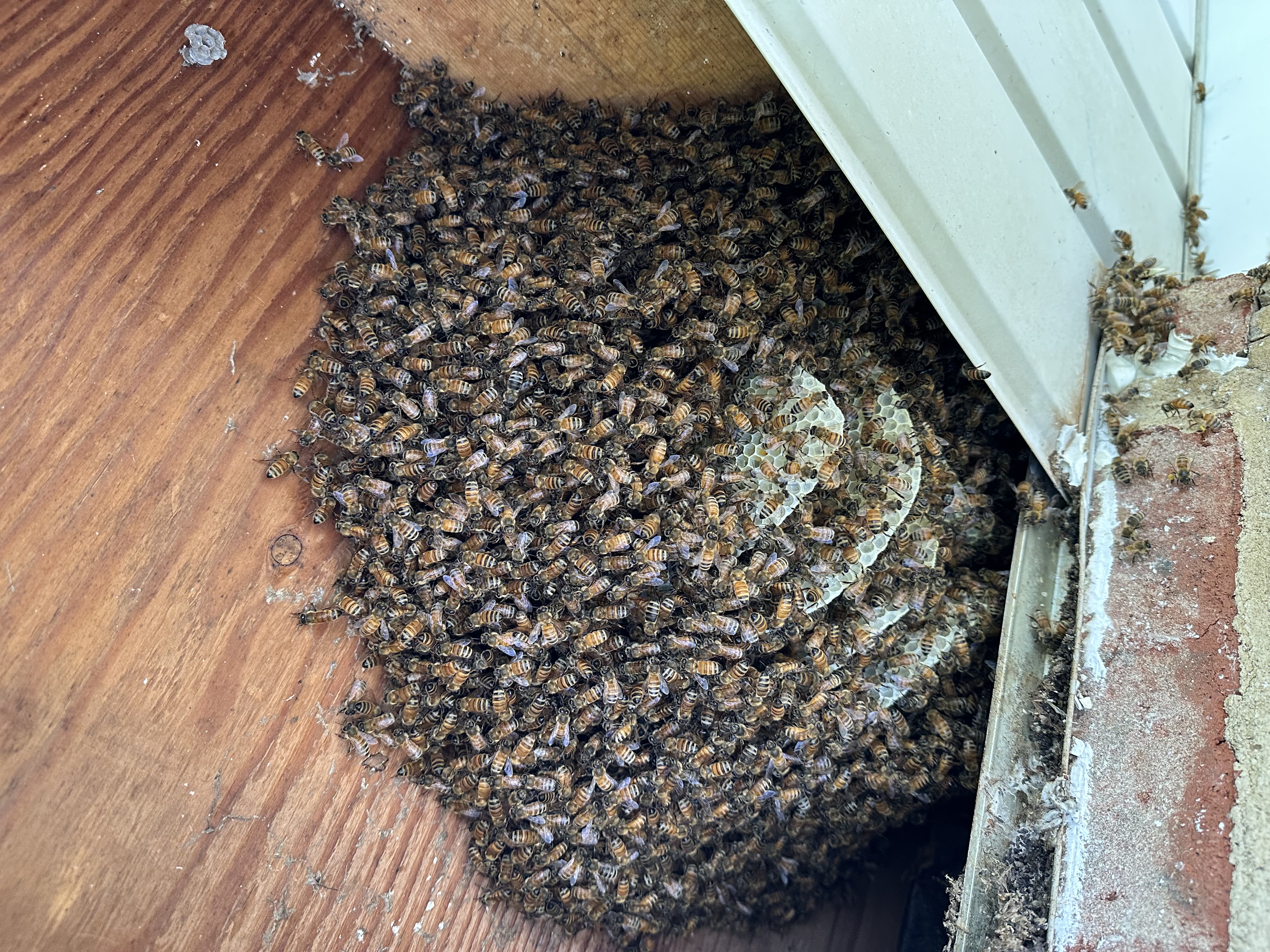
Fuzzy, amber-brown, heavy deliberate flight, often with pollen visible on their legs. If it's honey bees in your wall, we don't spray them. They get live removal and relocation — and unlike wasps, that job does mean opening the wall, because the comb and honey have to come out or you'll get robbing, staining, and a new swarm next spring. Different work, different price. We'll tell you which you have before anyone starts.
Carpenter Bees
Big and bumble-bee-like, but they bore perfectly round pencil-width holes into wood fascia, trim, decks, and rails rather than using an existing gap. Damage accumulates over years as they re-use and extend galleries. Treated and the galleries sealed — see stinging insects.
Not sure? Text a photo to 717-379-3248. Free identification, usually within the hour. About 1 in 3 "yellow jacket" calls we get turns out to be honey bees, which is exactly why we look first.
How We Treat a Wall or Siding Nest
For wasps, this is usually straightforward and does not involve opening your wall:
- Identify. Wasp or honey bee — this decides everything. Photo by text is often enough.
- Locate the real entry. Sometimes there's more than one, and treating only the obvious one leaves the colony a back door.
- Puff dust into the void. Done during the day — no waiting for dark. A low-volume insecticide dust is applied directly into the nest cavity through the entry point with equipment that actually carries into the void, not a surface spray at the opening. Workers track it in and it reaches the queen and brood.
- Let it die out and confirm. Traffic at the entrance drops off over 24–48 hours, but that is not the same as full control — see below on emerging brood. We check back rather than assuming.
- Then seal. Once the colony is confirmed dead, we can close the entry so next year's queens don't reuse it. Sealing is the last step, never the first.
Cost: soffit and accessible wall-void nests run $225–$375. Aerial hornet nests — the exposed grey ones — run $200–$325. A breakthrough into a living space runs $375–$500. Multiple nests on a property get bundled. Estimates are free, and a texted photo usually gets you an exact number without a visit.
What Not To Do
- Don't plug or caulk the hole while the nest is active. Covered above — this is how they end up in your bedroom.
- Don't spray from a can into the opening. It rarely reaches the nest, and it turns a defensive colony into an angry one at the exact spot you're standing.
- Don't open the wall yourself to "get at it." People do this and find out how large the colony is the hard way.
- Don't ignore it until winter. The colony does die off in fall, but abandoned nest material left in a void draws carpet beetles and other secondary pests, and a good site gets reused by next spring's queens.
If someone has been stung and shows swelling beyond the sting site, trouble breathing, or dizziness — call 911 first, then call us.
You May See Wasps Inside for a While Afterward. That's Normal.
Worth knowing before we treat, because it worries people who weren't warned. A dust treatment kills the adults that walk through it, but the brood already sealed in the cells keeps hatching. Every one of those newly emerged adults has to walk out through the treated nest, and if there's any gap at all between the void and your living space — a light fixture, an outlet, a baseboard, a ceiling vent — a few of them will find it.
That's the treatment working, not failing. They're coming out because the colony is collapsing, and they'll be sluggish. Vacuum them up as you see them and it tapers off on its own.
How long depends heavily on the time of year:
- Most of the season: 7 to 10 days for full control.
- August, at peak nest size: 14 to 21 days. There is simply far more brood still to emerge, so it takes longer for the last of them to work through.
If you're still seeing steady numbers well past that window, call us — that's worth a look. A handful trickling out inside the window is expected.
When They Break Through Into the House
This is the version of a wall nest that stops being a nuisance and becomes an emergency. Drywall is soft, and a colony that has been sprayed, sealed out, or simply run out of room will chew straight through it. What you get is wasps coming out of a ceiling vent, a light fixture, a baseboard gap, or a hole in the wall itself — inside the house, in numbers, with nowhere to go.
This gets same-day priority, and it is the one situation where we work inside. Our pest control is perimeter-only for routine work, but a breakthrough is not routine.
- Shut the room off if you can — close the door, block the gap under it with a towel. Don't try to fight them in the open.
- Don't spray it yourself. Aerosol into an active breakthrough scatters them through the rest of the house and makes the room unusable for us as well as you.
- We vacuum the wasps out first. That clears the living space immediately, which is what actually matters to you in that moment, and it does it without filling the room with product.
- Then the area gets treated so the rest of the colony coming through the same path doesn't just replace them.
- The void still has to be dealt with from the outside afterward — the breakthrough is the symptom, the nest is still in the wall.
Cost: breakthroughs into a living space run $375–$500. That reflects the same-day response, the interior work, and the fact that it is two jobs — clearing the house and then dealing with the nest.
Where We Cover
All of the City of Harrisburg (17101–17104, 17109, 17110) — Midtown, Allison Hill, Uptown, Bellevue Park, Boas Heights, Italian Lake. Inner suburbs: Penbrook, Paxtang, Steelton, Highspire. Outer suburbs: Colonial Park, Lower Paxton, Susquehanna Township, Linglestown. Plus Hershey, Hummelstown, Mechanicsburg, Camp Hill, Palmyra, Middletown, Carlisle, and Lebanon.