
There's a nest by the back door and now nobody wants to use it. If someone in the house is allergic, that changes the math entirely. Yellow jackets and hornets get more aggressive and more numerous straight through August and September, and they defend a nest hard — this is the one pest problem we genuinely tell people not to handle themselves. Same-week response on active nests, faster when it's near a door, deck, or play area.
Active Nest? Call or Text 717-379-3248Stinging insect work is one part of our broader pest control service. This page covers what we treat and how. For Harrisburg-specific yellow jacket and hornet emergencies, see yellow jacket removal in Harrisburg. If something is nesting in a hole in your lawn, start with ground bees in your yard — it walks you through telling yellow jackets apart from harmless mining bees. If it's going into your siding or a wall void, see wasps in your siding or wall first, because sealing the hole makes it worse.
The most aggressive and most common stinging-insect call we get from late summer through fall. They build nests in the ground, wall voids, soffits, and under attic insulation. By August a single colony can have 2,000–5,000 workers. We treat at the entry point. A nest inside a structure takes 7 to 10 days for full control most of the season, and 14 to 21 days in August when nests are at peak size. The reason is brood: the dust reaches the adults, but the young sealed in the cells keep hatching and have to walk out through the treated nest. Expect activity in that window, and expect a few to turn up inside the house through a light fixture or a baseboard gap. That is the colony collapsing, not the treatment failing. See wasps in your siding or wall. We treat most if not all yellow jacket nests we're called to — this is not an insect we recommend living alongside, and an active colony needs to be exterminated and the nest removed. What we don't do is sealing and repair work: closing the void, replacing siding, or patching the structure afterward is a job for you or a contractor, and we'll show you exactly where and what's needed rather than quote it ourselves.
Build the iconic football-shaped gray paper nest hanging from tree limbs, under eaves, in gutters, and on houses. Despite the name they're actually a type of yellow jacket — but larger, more aggressive, and their sting carries more venom. A typical mature nest holds 400–700 workers and can be the size of a basketball.
Build open-cell umbrella-shaped nests under deck rails, eaves, soffits, mailboxes, grills, swing sets, and porch lights. Smaller colonies than yellow jackets — usually 20–30 workers. Less aggressive overall, but they will defend the nest if disturbed.
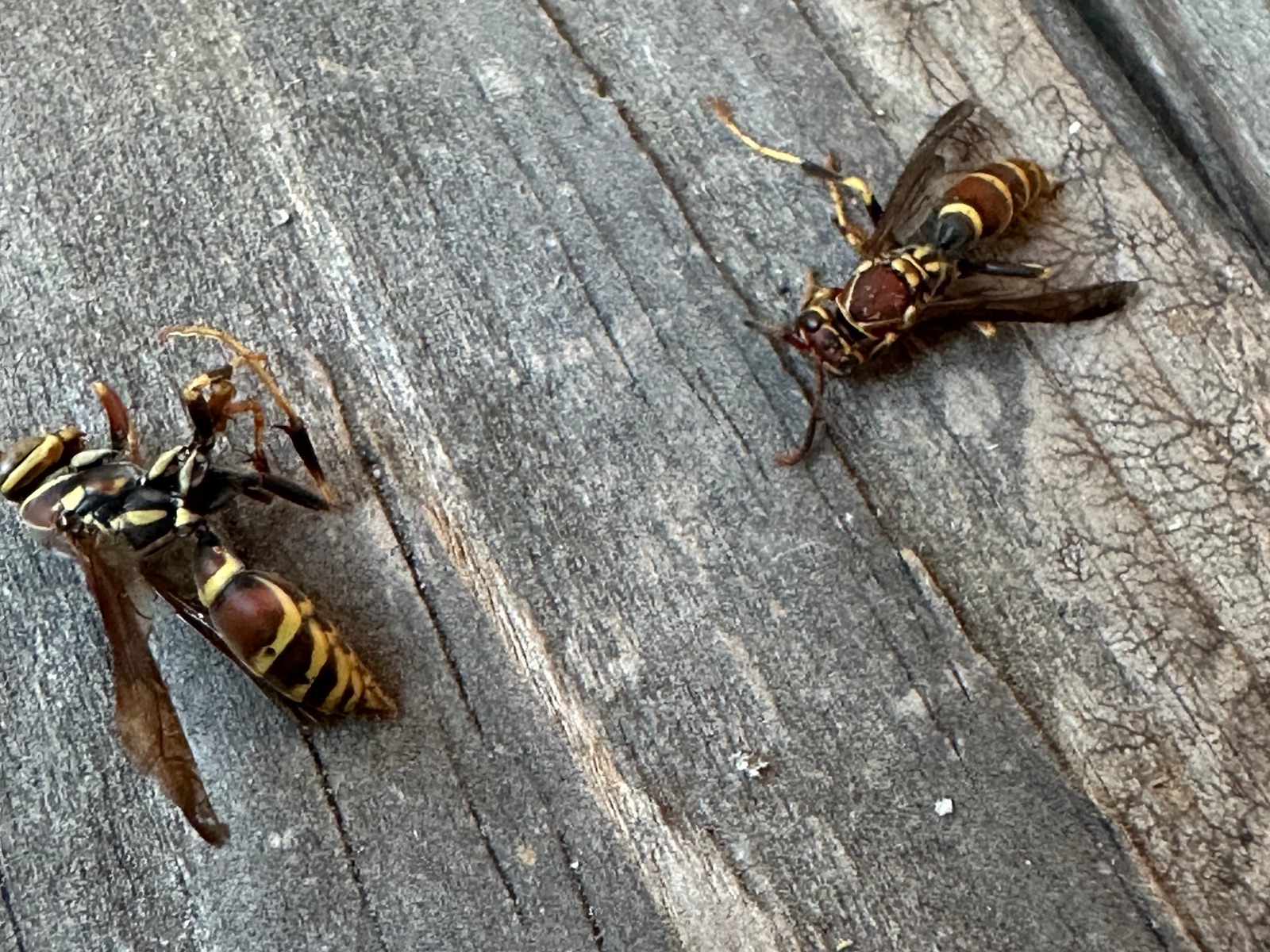
Large (up to 1.5 inches), reddish-brown and yellow, active at night — often drawn to lit windows. Typically nest in hollow trees, attic spaces, and wall voids. Less aggressive than yellow jackets but their large size makes them alarming.
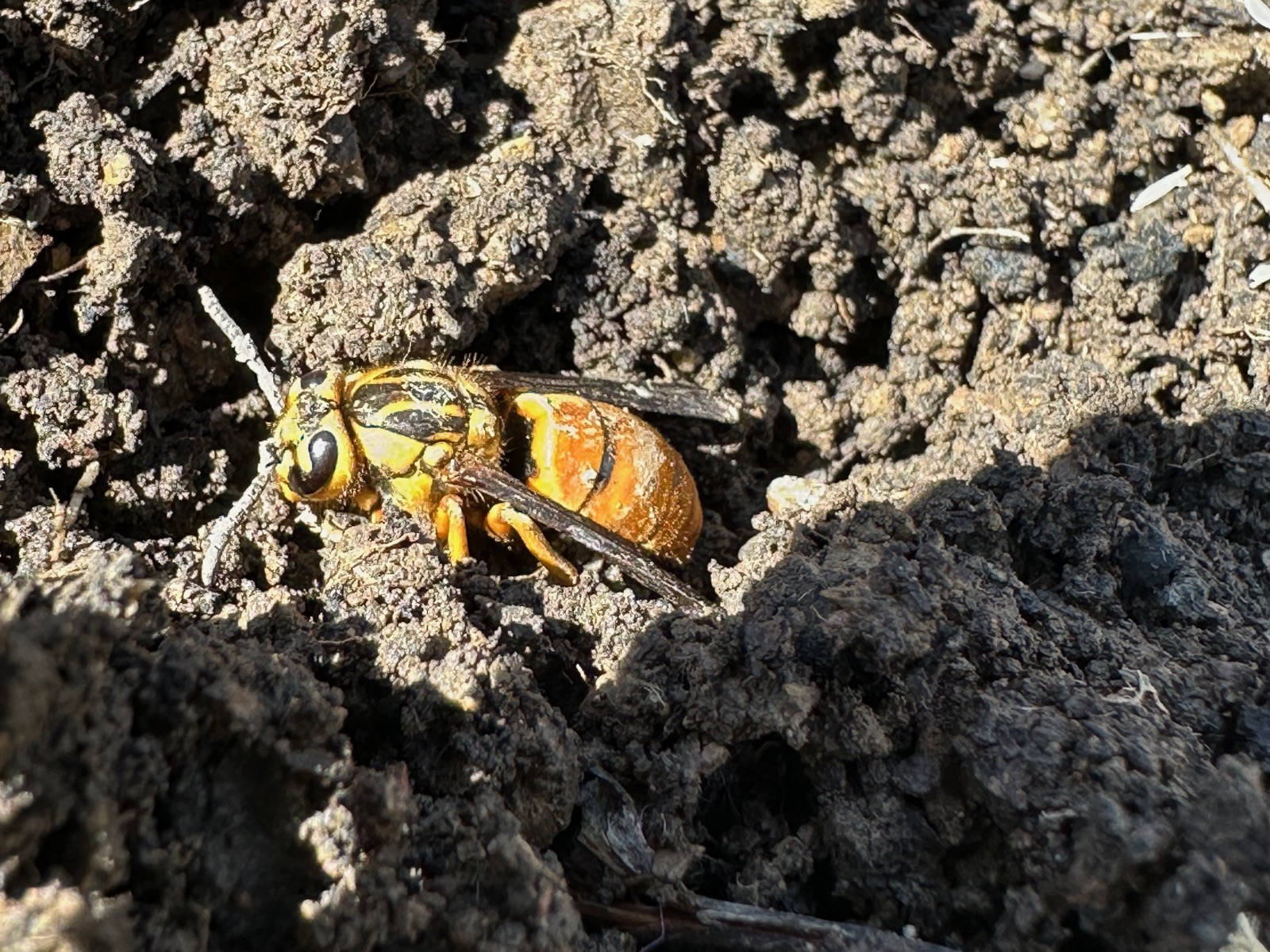
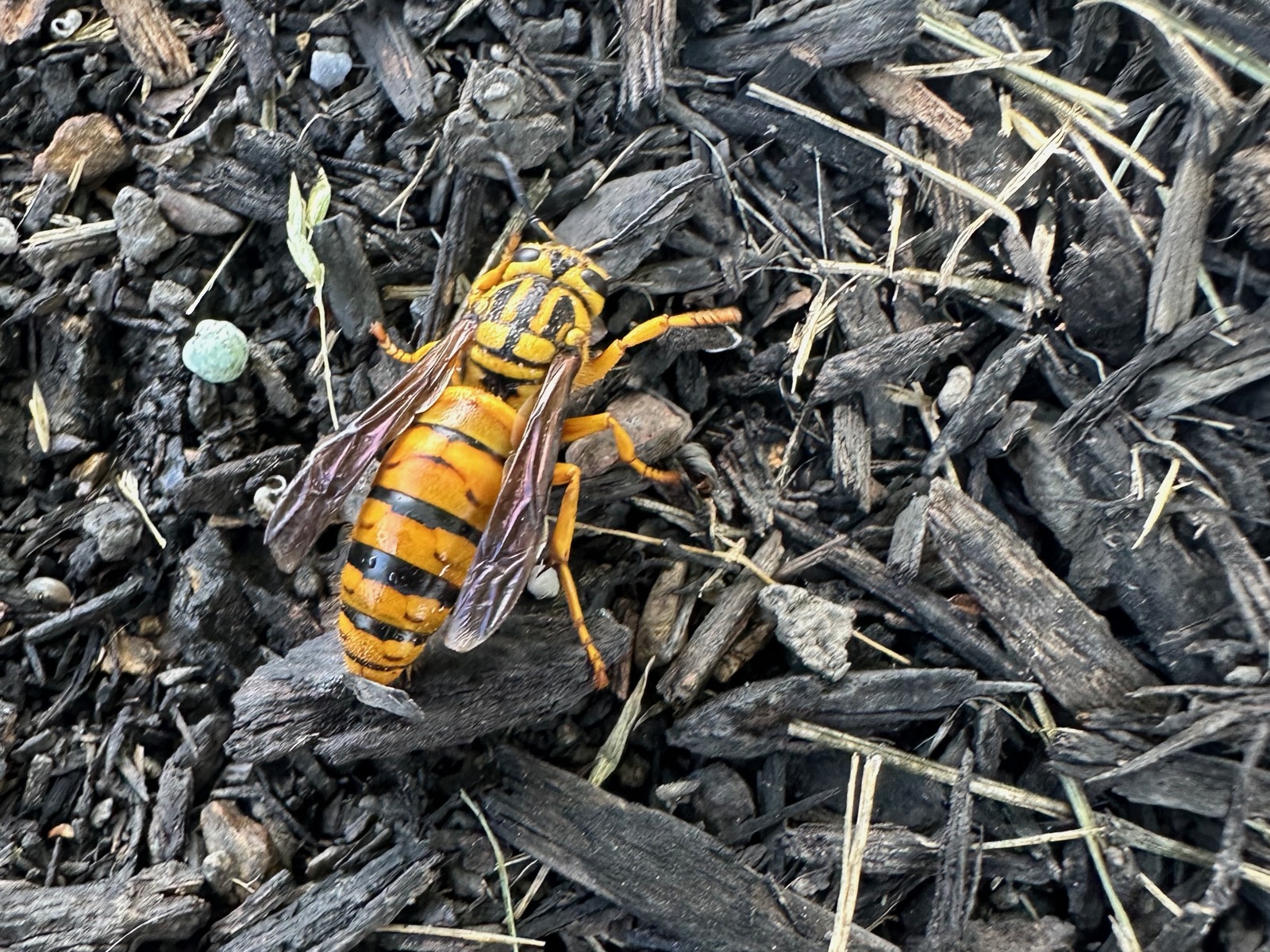
Large (1.5–2 inches), striking yellow-and-black solitary wasps that dig burrows in lawn areas. Despite their intimidating size they're not aggressive — males can't sting at all. Cicada killers specifically are the one stinging insect where doing nothing is often the right answer — they're solitary, the males can't sting at all, and the burrows are gone by September. We treat them when activity is heavy in a high-traffic area and tell you honestly when it isn't worth it. This does not apply to yellow jackets — a yellow jacket nest is a colony that gets more aggressive as the season goes on, and nearly all of them need to be treated and removed. Full cicada killer guide →
Look like bumble bees but with a shiny hairless abdomen. They drill perfectly round half-inch holes into deck rails, fascia boards, eaves, fence posts, and exposed beams. The problem isn't safety — it's structural damage. We apply insecticidal dust into each active hole and leave the holes open — that's deliberate. Sealing a bee in doesn't kill it; it just makes it chew a new way out, and in fascia or soffit wood that new way can go inward, into the structure. Left open, returning females keep walking through the dust and carrying it down the gallery, which is what reaches the brood. Once the gallery is finished, the holes do need filling — wood putty or caulk, then paint. Unlike a cicada killer burrow in soil, a hole bored into wood doesn't close on its own, and an open gallery is an invitation to next year's females.
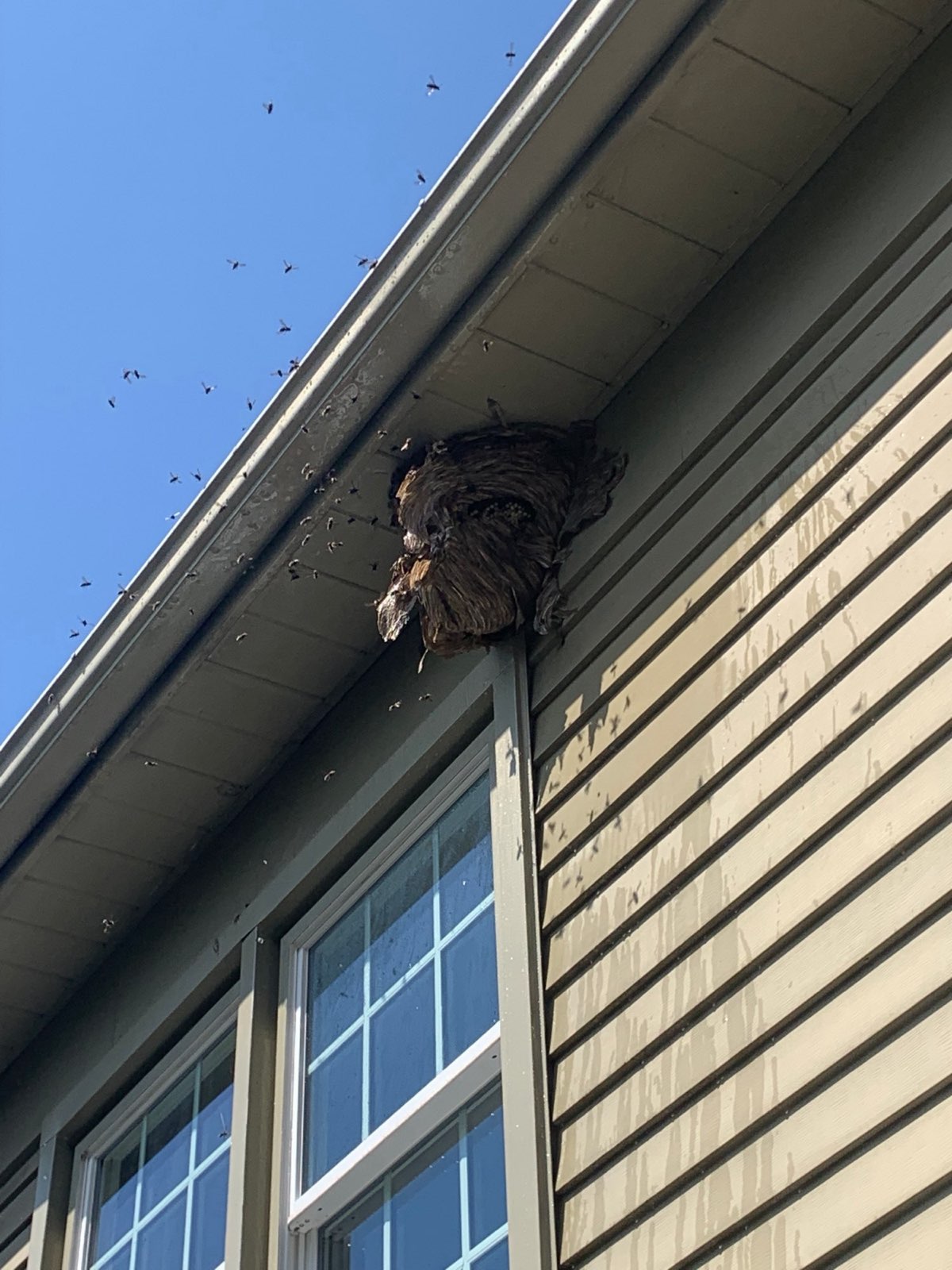
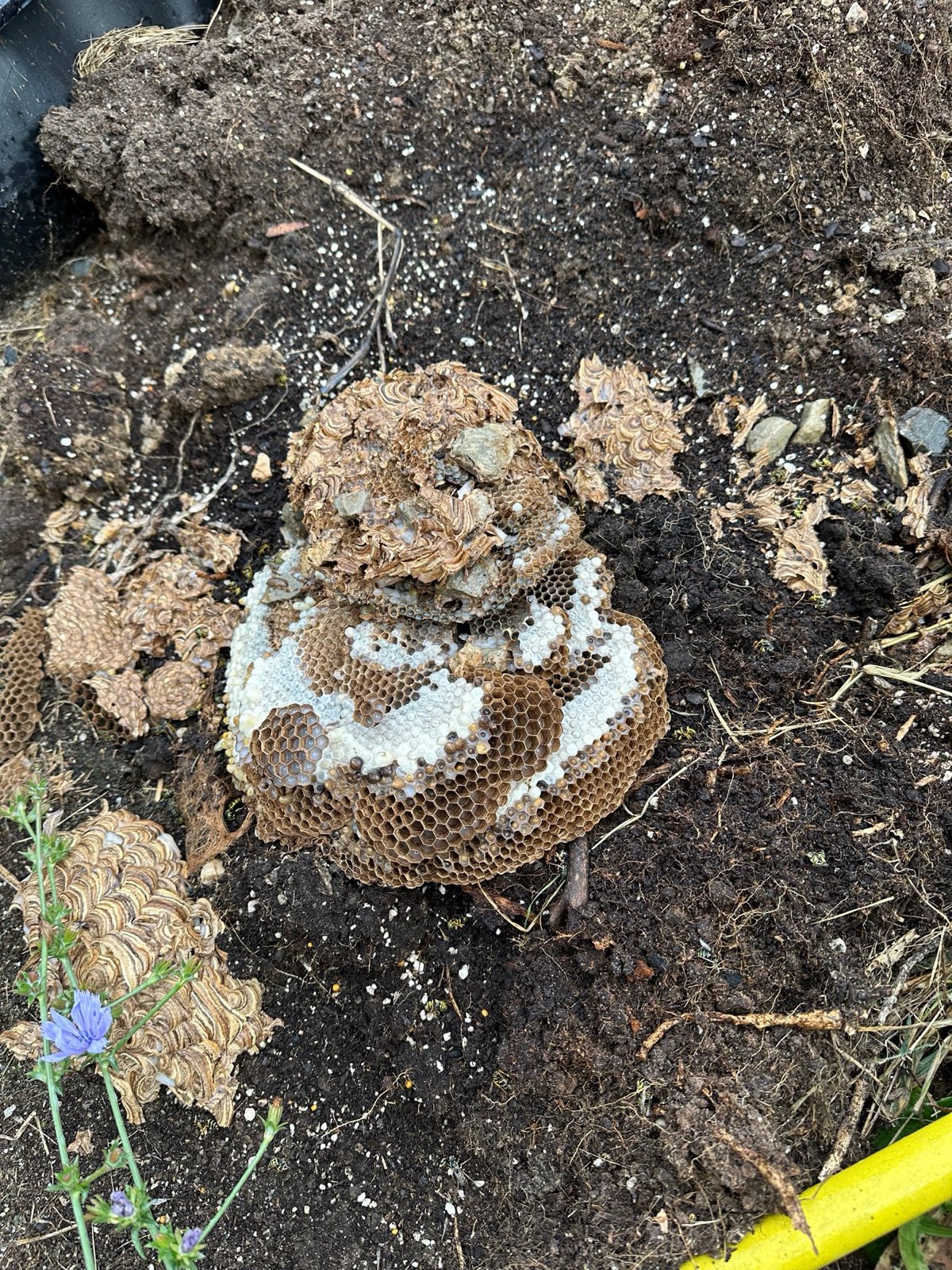
Our standard treatment is a low-volume insecticide dust put directly into the nest. It's the fastest, least invasive, and least expensive way to kill a colony, and it's the right call for most homes. But some customers need no pesticide used at all: a beekeeper with hives nearby, a vegetable or pollinator garden right next to the nest, someone in the house with a chemical sensitivity.
For those jobs we do it pesticide-free. We cut or dig the nest out and vacuum the colony, then take the nest with us. Nothing is sprayed or dusted, and nothing is left behind. That works for yellow jackets in the ground or in a wall, bald-faced hornets, and paper wasps. Three things to know going in:
If pesticide-free matters to you, say so when you call. It changes how we plan the job.
By August a yellow jacket colony is 2,000–5,000 workers, it is defensive, and if it is inside a wall it takes 14 to 21 days to fully control because of all the brood still waiting to hatch. The same nest in June is a queen and a few dozen workers. Same house, same hole in the siding, a fraction of the work.
So if you notice traffic going into a gap in early summer and think you will deal with it later — later is the expensive version, and it is the version where you are also finding wasps in the kitchen for three weeks afterward.
Overwintered queens come out in April and May on their own, looking for somewhere to start: a soffit corner, a gap behind siding, a void under a step, an old rodent burrow in the lawn. They are not a colony yet — they are one insect making a decision.
A perimeter treatment on those surfaces through the spring makes your house a poor candidate. A queen that starts somewhere else is a nest you never pay to have removed. On properties that get nests every single year — and some do, because the site suits them — keeping the perimeter on a regular schedule through spring is what actually breaks the pattern, rather than treating the same soffit every August.
That is ordinary perimeter pest control, not a separate stinging insect service. It also handles the ants and spiders while it is there.
We have a page for each of the situations we get called about most:
We serve Dauphin, Cumberland, Lebanon, Perry, York, and Lancaster Counties — including:
Harrisburg, Paxtang, Penbrook, Steelton, Highspire, Middletown, Hummelstown, Hershey, Palmyra, Annville, Cleona, Lebanon, Grantville, Linglestown, Colonial Park, Susquehanna Township, Lower Paxton, Camp Hill, Mechanicsburg, Lemoyne, New Cumberland, Wormleysburg, Enola, Marysville, Halifax, Millersburg, Elizabethtown, Mount Joy, Mount Wolf, Manchester, Dillsburg, Carlisle, Boiling Springs, and surrounding Central PA communities.
Same-week response on active stinging insect nests in Harrisburg and Central PA. Free estimates. Pennsylvania-licensed pesticide applicator.
Call or Text 717-379-3248