
The nest you barely noticed in June can have 4,000 workers by Labor Day. Here's the timeline behind that — and what to do once you see them swarming the deck.
Yellow jackets in Central PA build a brand new nest every year — they don't reuse old ones. Understanding the timeline explains why a property that had no problem in May suddenly has 50 wasps on the picnic table in August.
A single fertilized queen wakes up from overwintering and starts a new nest from scratch. She lays the first eggs, raises the first workers, and the nest is the size of a golf ball. You won't notice it.
Workers take over feeding the colony. The queen does nothing but lay eggs. The nest doubles in size every couple of weeks. Most homeowners notice activity now — a steady stream of wasps coming and going from a hole in the lawn, a soffit, a porch joist, or a bush.
This is the dangerous window. The colony is at maximum size right when natural food sources (caterpillars, soft fruit, garbage) start dropping off. The workers get desperate, switch from hunting to scavenging, and start swarming everything sweet or meaty on your deck. They sting on much less provocation than they did in June.
The first hard frost kills the colony. Only new queens (mated daughters) survive, find a sheltered spot to overwinter, and start the cycle next spring on a different patch of your property.
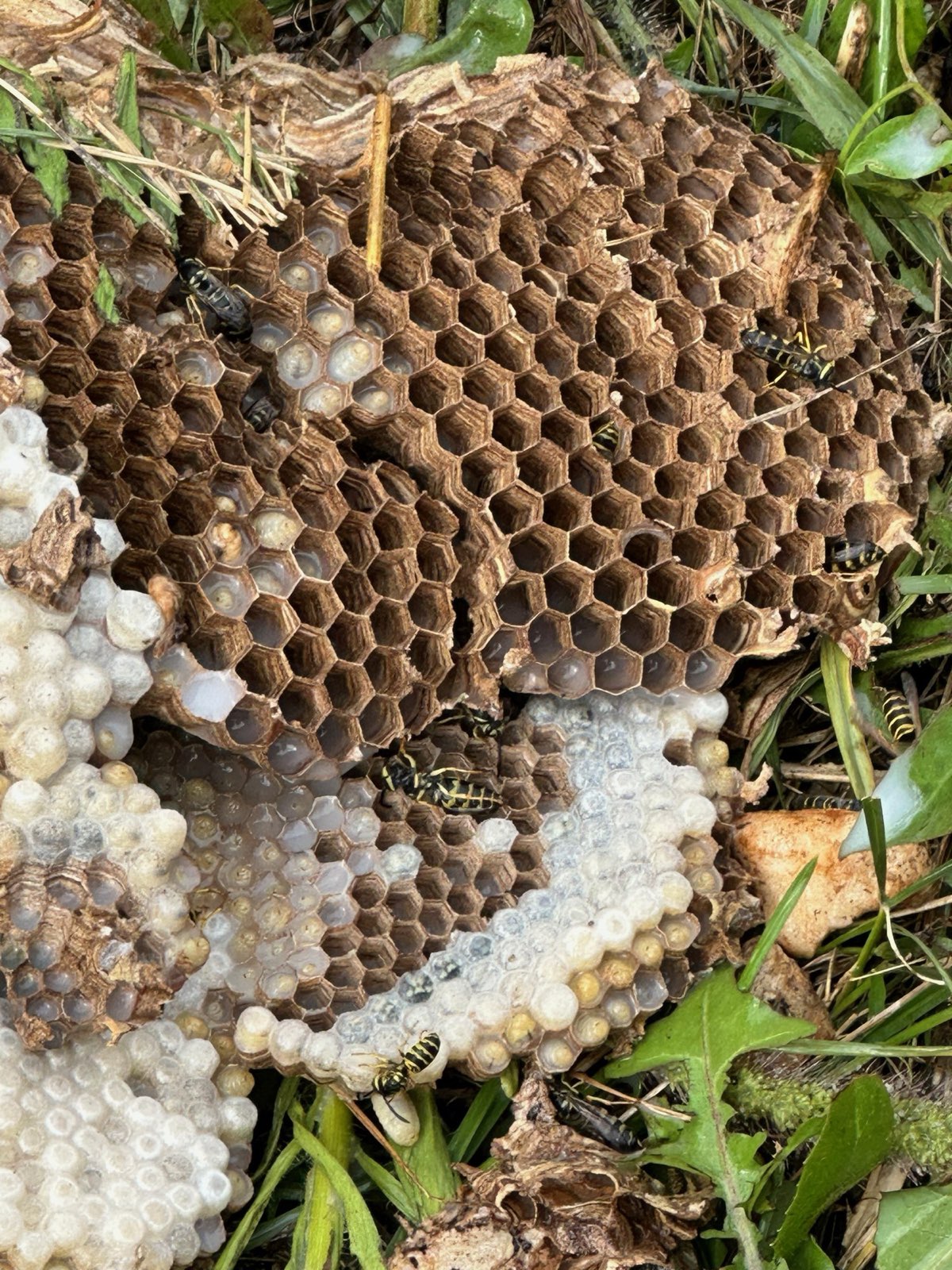
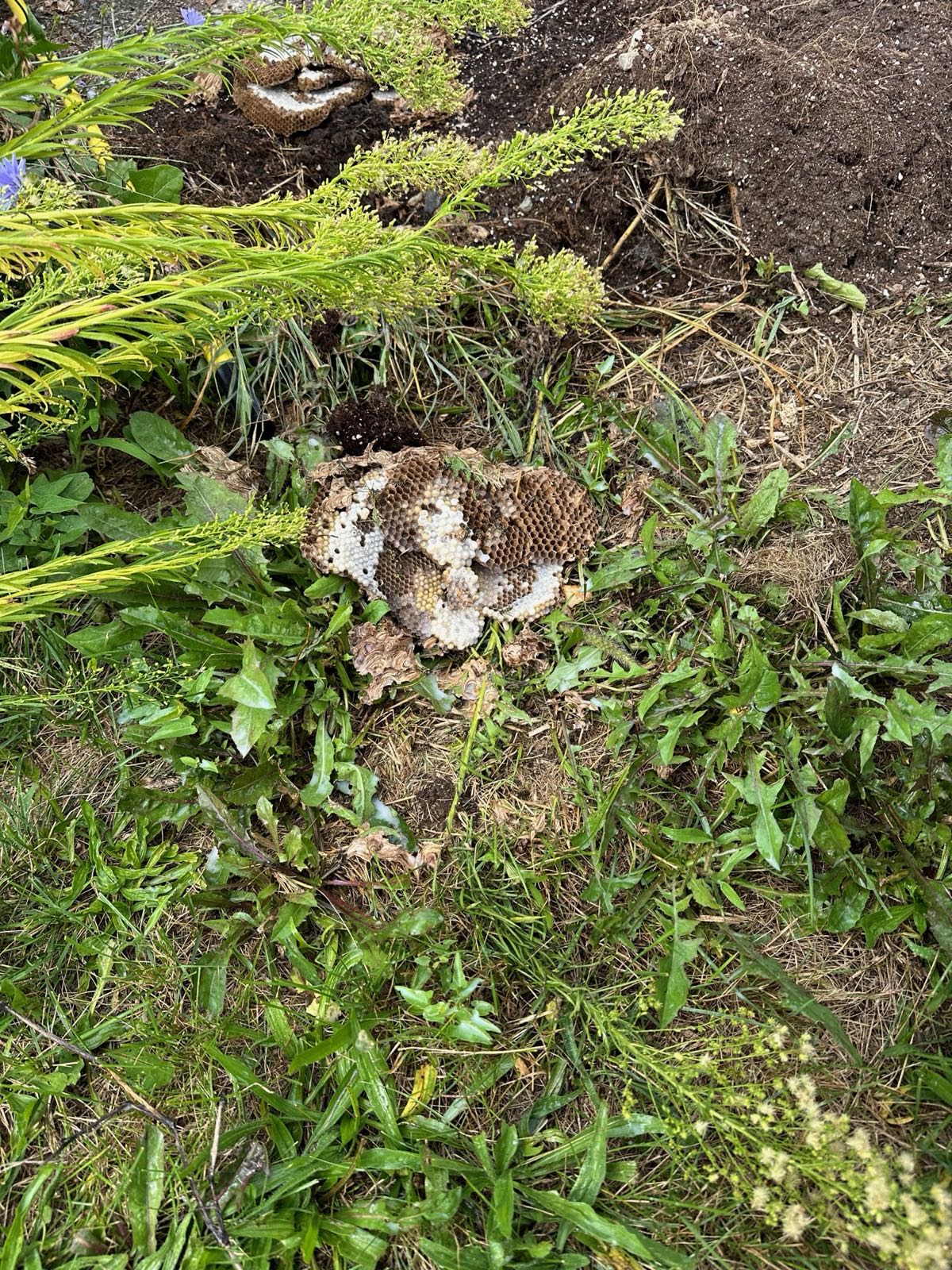
Yellow jackets nest in two general categories — ground nests and aerial nests. Both common in the Harrisburg area:
Note: a basketball-sized grey papery nest hanging visibly from a tree branch is almost always a bald-faced hornet (not yellow jackets). Same family, similar behavior, and we remove them too — but the nest shape is the giveaway.
Ground nests get treated during the day. We use a low-volume insecticide dust puffed deep into the entrance — it kills the foragers as they pass through, then carries down into the nest and reaches the queen and brood. Usually one treatment. Where the situation calls for it, the nest gets dug out and removed instead, which ends it on the spot.
Aerial nests in soffits and walls are similar — dust applied to the entrance with extension tools, then the entrance is left open for 48–72 hours so returning workers contact the residue. We don't seal the hole until the nest is confirmed dead, for the reason above.
Visible aerial nests (paper wasp or bald-faced hornet, hanging from a branch or under a porch ceiling) are knock-down jobs with the right gear and PPE.
If you have an active nest in August or September — especially near a doorway, kids' play area, or somewhere you can't avoid — don't wait. Call or text 717-379-3248. We prioritize active stinging nests for same-week response and often same-day in the worst cases.
Call or text 717-379-3248. We prioritize active nests — same-week response, often same-day for high-risk locations.
Call or Text 717-379-3248